

Exploring the Evolving Landscape: Key Amendments to UAE Corporate Governance Rules
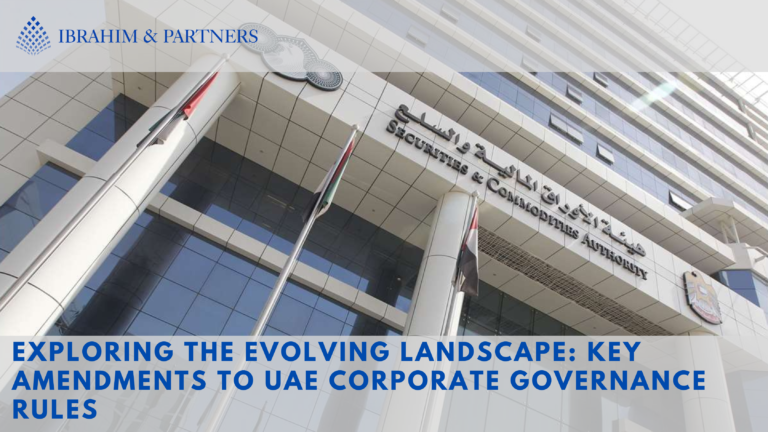
The UAE's corporate governance framework has undergone significant enhancements with the issuance of Cabinet Resolution No. 40 of 2023 (the "Resolution"), which amends certain provisions of Cabinet Resolution No. 58 of 2020 concerning the governance rules for public joint stock companies. These amendments, effective from January 1, 2024, introduce important changes aimed at strengthening corporate governance practices, enhancing board effectiveness, and aligning UAE standards with international best practices.
Background
Corporate governance in the UAE has evolved substantially over the past decade, with the introduction of comprehensive governance rules for public joint stock companies under Cabinet Resolution No. 58 of 2020. These rules established foundational principles for board composition, independence, committees, and shareholder rights. The recent amendments under Resolution No. 40 of 2023 build upon this foundation by addressing emerging challenges and incorporating lessons learned from market practice.
Key Amendments Introduced by the Resolution
1. Enhanced Board Independence Requirements
The Resolution strengthens independence criteria for board members by introducing more stringent disqualification conditions:
- A board member shall not be considered independent if he/she, his/her spouse, or first-degree relatives have received remuneration from the company or its subsidiaries (excluding board fees and pension benefits) within the preceding three years.
- Independence is compromised if the board member has been an executive officer of the company or its subsidiaries within the preceding five years (extended from three years).
- A board member loses independence status if he/she, his/her spouse, or first-degree relatives have material business relationships with the company exceeding 5% of the company's annual revenue or AED 5 million (whichever is lower) in any of the preceding three years.
- Cross-directorships are now more strictly regulated: a board member shall not be independent if he/she serves on the board of another company where more than two executives of the subject company also serve as board members or executives.
Additionally, the Resolution mandates that at least one-third of board members must be independent (increased from the previous requirement of at least two independent members), with a minimum of two independent members regardless of board size.
2. Board Diversity and Skills Matrix
For the first time, UAE corporate governance rules explicitly address board diversity and composition:
- Companies must develop and disclose a board skills matrix identifying the mix of skills, experience, and attributes required for effective board performance.
- The skills matrix must consider diversity dimensions including gender, age, professional background, industry experience, and international exposure.
- While no mandatory gender quota is imposed, companies are encouraged to have at least one female board member and must explain in their annual governance report if they fail to achieve gender diversity.
- Boards must ensure representation of members with financial literacy, particularly for companies in financial services, real estate, and other capital-intensive sectors.
3. Enhanced Role of the Board Chair
The Resolution clarifies and strengthens the role of the Board Chair:
- The positions of Board Chair and Chief Executive Officer must be held by different individuals, eliminating the previous exception that allowed combination of roles with shareholder approval.
- The Board Chair must be an independent board member in companies where the government or a single shareholder holds more than 50% of shares.
- The Board Chair is expressly responsible for ensuring effective board deliberations, facilitating constructive challenge, and safeguarding minority shareholder interests.
- The Board Chair must meet separately with independent directors at least twice annually without management present.
4. Strengthened Board Committees
The Resolution enhances requirements for key board committees:
Audit Committee:
- Must comprise exclusively of independent directors (increased from majority independence requirement).
- At least one member must have professional accounting or financial expertise (e.g., CPA, CFA, or equivalent qualification).
- The committee must review and approve all related party transactions exceeding AED 1 million or 1% of company assets (whichever is lower), rather than merely reviewing them.
- Must meet at least quarterly and hold separate sessions with internal and external auditors without management present.
Remuneration Committee:
- Must comprise majority independent directors.
- Must develop and disclose a clear remuneration policy linking executive compensation to long-term company performance and ESG metrics.
- Must conduct annual reviews of CEO and senior management compensation against market benchmarks and performance metrics.
- Must ensure that at least 40% of variable compensation for senior executives is deferred for a minimum of three years.
Nomination and Governance Committee:
- Must comprise majority independent directors.
- Responsible for developing board succession plans and evaluating board performance annually.
- Must conduct external board evaluations by independent third parties at least once every three years.
5. Related Party Transactions
The Resolution introduces more robust oversight of related party transactions:
- All material related party transactions must be approved by the Audit Committee prior to board consideration.
- Transactions exceeding 5% of company assets require approval by shareholders representing at least 75% of votes cast at a general assembly (excluding interested parties).
- Companies must maintain a publicly accessible register of all related party transactions disclosed in annual reports.
- Directors with interests in proposed transactions must abstain from board discussions and voting on such matters.
6. Environmental, Social, and Governance (ESG) Disclosures
Reflecting global trends, the Resolution mandates enhanced ESG reporting:
- Companies must disclose ESG policies, targets, and performance metrics in annual reports.
- Boards must establish oversight mechanisms for ESG risks and opportunities, either through a dedicated ESG committee or by assigning responsibility to an existing committee.
- Companies in environmentally sensitive sectors (energy, utilities, manufacturing) must disclose carbon emissions data and climate transition plans.
- Social disclosures must include workforce diversity statistics, health and safety performance, and community investment initiatives.
7. Shareholder Rights and Engagement
The Resolution enhances mechanisms for shareholder participation and protection:
- Companies must establish formal channels for shareholder engagement, including annual investor days and dedicated investor relations functions.
- Minority shareholders representing at least 3% of share capital may place items on the agenda of annual general assemblies (reduced from 5% threshold).
- Electronic voting must be facilitated for all shareholders, including those unable to attend general assemblies physically.
- Companies must respond publicly to shareholder proposals that receive support from at least 20% of votes cast.
8. Risk Management and Internal Controls
Strengthened requirements for risk oversight include:
- Boards must approve a comprehensive risk management framework covering strategic, operational, financial, compliance, and emerging risks (including cybersecurity and climate risks).
- Companies must appoint a Chief Risk Officer reporting directly to the board or its risk committee in cases where annual revenue exceeds AED 500 million.
- Internal audit functions must be organizationally independent, with the head of internal audit appointed and dismissed only with Audit Committee approval.
- Boards must receive quarterly risk reports highlighting significant risk exposures and mitigation measures.
9. Director Training and Continuous Development
The Resolution emphasizes ongoing director education:
- All board members must complete at least 20 hours of governance-related training annually.
- Newly appointed directors must complete an induction program covering company operations, strategy, governance framework, and key risks within three months of appointment.
- Training records must be maintained and disclosed in annual governance reports.
10. Enhanced Disclosure Requirements
Companies must provide more transparent governance disclosures:
- Annual governance reports must include individual director attendance records at board and committee meetings.
- Companies must disclose reasons for any director who attended less than 75% of meetings during the year.
- Details of directors' other directorships and potential conflicts must be disclosed.
- Companies must explain any deviations from governance code provisions on a "comply or explain" basis.
Implementation Timeline
The amendments introduced by Resolution No. 40 of 2023 became effective on January 1, 2024. However, a transitional period applies to certain provisions:
- Board composition requirements (independence thresholds, separation of Chair/CEO roles): Companies have until the date of their first annual general assembly following January 1, 2024 to achieve compliance.
- Committee composition requirements: Six-month transition period allowed for appointing qualified independent members.
- ESG disclosure requirements: Phased implementation with basic disclosures required for 2024 reports and comprehensive disclosures required for 2025 reports onwards.
Impact on UAE Capital Markets
These amendments are expected to deliver several positive outcomes:
- Enhanced Investor Confidence: Stronger governance standards improve transparency and accountability, attracting both domestic and international institutional investors.
- Improved Board Effectiveness: Clearer roles, enhanced independence, and diversity requirements foster more robust board deliberations and oversight.
- Better Risk Management: Strengthened risk oversight frameworks help companies navigate complex business environments and emerging threats.
- Alignment with Global Standards: The amendments bring UAE governance practices closer to international frameworks such as the OECD Principles of Corporate Governance and UK Corporate Governance Code.
- Valuation Premium: Companies with strong governance practices typically command higher valuation multiples, benefiting shareholders.
Practical Steps for Companies
Public joint stock companies should take the following actions to ensure compliance:
- Conduct a gap analysis comparing current governance practices against new requirements.
- Review board composition and initiate recruitment processes for independent directors as needed.
- Update governance documents including board charters, committee terms of reference, and internal policies.
- Establish or enhance ESG oversight mechanisms and disclosure processes.
- Implement director training programs addressing new requirements.
- Enhance internal systems for tracking and disclosing governance metrics.
- Engage with shareholders to communicate governance enhancements and gather feedback.
Conclusion
Cabinet Resolution No. 40 of 2023 represents a significant milestone in the evolution of corporate governance in the UAE. By introducing more stringent independence requirements, promoting board diversity, enhancing committee effectiveness, and mandating ESG disclosures, the Resolution positions UAE public companies to operate with greater transparency, accountability, and sustainability.
While implementation will require effort and resources, the long-term benefits—enhanced investor confidence, improved decision-making, better risk management, and stronger corporate performance—justify the investment. Companies that proactively embrace these governance enhancements will be better positioned to thrive in an increasingly complex and competitive business environment.
As the UAE continues its economic diversification journey under Vision 2031, robust corporate governance will serve as a cornerstone for sustainable growth, investor protection, and market integrity.
Malack El Masry
Partner
(+971) 503977689
[email protected]
Charlotte Jackson
Senior Associate
(+971) 50 9910 387
[email protected]
Source: IN'P Ibrahim & Partners (inp.legal)